Destinations · August 9, 2026 · 9 min read
Where to see the northern lights and the best time to go
Where to see the northern lights in 2026 and 2027: where the auroral oval sits, when the season runs, how many nights to book and why cloud beats any app.
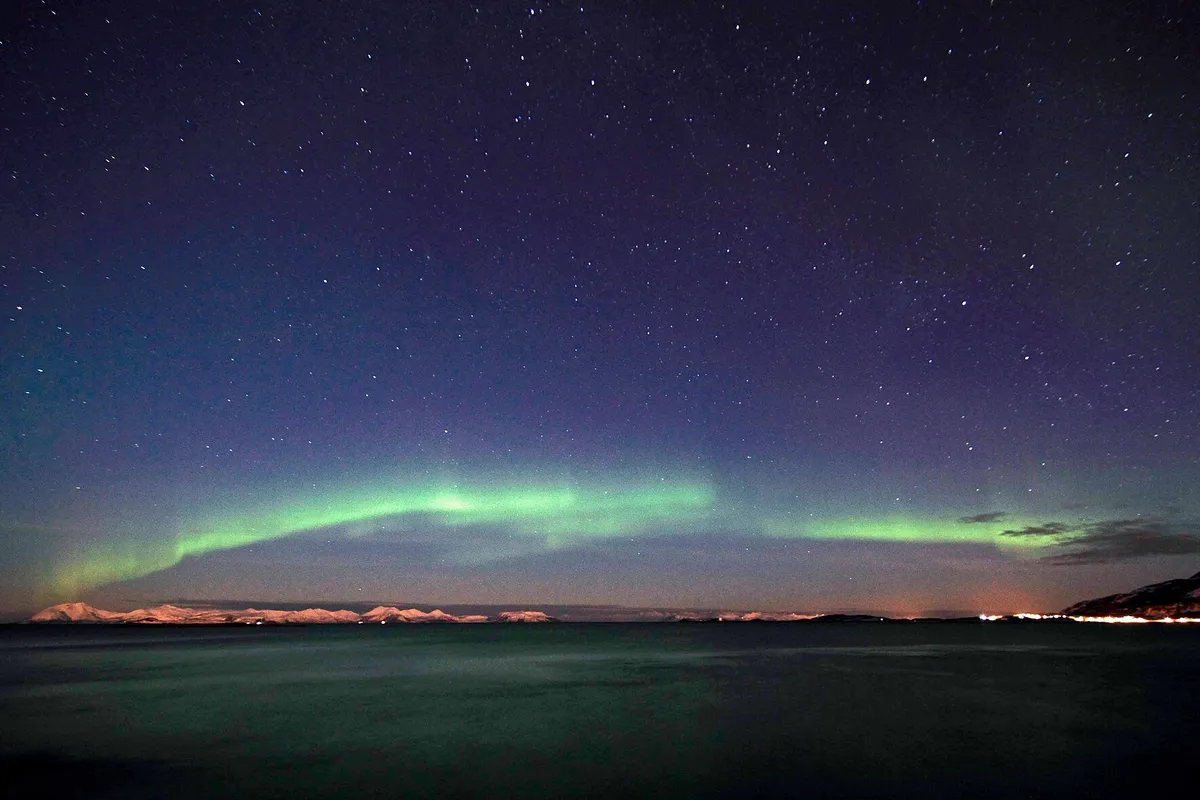
Where to see the northern lights looks like one question and is really three. A geographical one, a calendar one, and one almost nobody takes seriously: how many nights you stand still in the same place. The first two are settled with a map; the third decides whether you come home with photographs or a shrug.
We are publishing this now because the season opens in late August and Visit Tromsø warns that the aurora activities and the accommodation are often fully booked. And because the aurora is the one travel spectacle nobody can reserve for you: no weather service on Earth publishes a seasonal aurora forecast, and the serious forecast arrives half an hour ahead.
Everything below comes from NOAA, the Geophysical Institute at the University of Alaska Fairbanks, the Norwegian Centre for Space Weather and the met offices of Iceland and Finland.
Where to see the northern lights: the auroral oval and the band that works
Earth's magnetic field steers the incoming electrons into two ovals centred on the magnetic poles, and the aurora lights up 80 to 500 kilometres up. NOAA's explainer on the aurora is blunt about the useful band: under an oval between roughly 60 and 75 degrees of latitude, the aurora can be seen on more than half the nights of the year. In its quiet state that band is thin: the Geophysical Institute at Fairbanks puts it near 67 to 68 degrees geomagnetic.
Geomagnetic, not geographic. The magnetic pole moves, which is why NOAA and the British Geological Survey reissue the World Magnetic Model at least every five years. No official table of geomagnetic latitudes exists for holiday towns, so these are geographic.
- Tromsø, Norway: 69.68°N
- Abisko, Sweden: 68.35°N
- Kiruna, Sweden: 67.83°N
- Rovaniemi, Finland: 66.48°N, on the Arctic Circle
- Fairbanks, Alaska: 64.82°N
- Reykjavík, Iceland: 64.13°N
- Yellowknife, Canada: 62.47°N
At average activity NOAA names Fairbanks, Dawson City, Churchill, Yellowknife, southern Greenland, Reykjavík and Tromsø as good bets for aurora nearly overhead. In the south the oval falls almost entirely over Antarctica: the Australian Bureau of Meteorology's table puts southern Tasmania in the lowest band it lists, unsettled, and all of Tasmania in the next, active; NOAA adds that Hobart needs fairly strong activity.
The best time to see the northern lights: season and hours
The season exists not because winter has more aurora but because summer up there has no darkness. Sunlight and cloud are the two biggest obstacles, NOAA says, and the Norwegian Centre for Space Weather puts the blind window from mid April to early September.
- Fairbanks, per the Geophysical Institute at the University of Alaska: roughly 21 August to 21 April, with a warning to skip the two ends of the season.
- Tromsø, per the local tourist board: late August to early April, with most evening activities running from September.
- Rovaniemi: late August to early April; Greenland: late August to April.
- Abisko, per the Swedish Tourist Association: August to April, with the best odds from mid November to mid March.
On timing the three sources agree in different words. NOAA points at the hours either side of local midnight, 10 pm to 2 am; Fairbanks widens it to 9 pm and 3 am; the Norwegian centre says 20:00 to 02:00 and adds that displays outside the window are not unusual. You move dinner, not your alarm.
Why September and March beat December
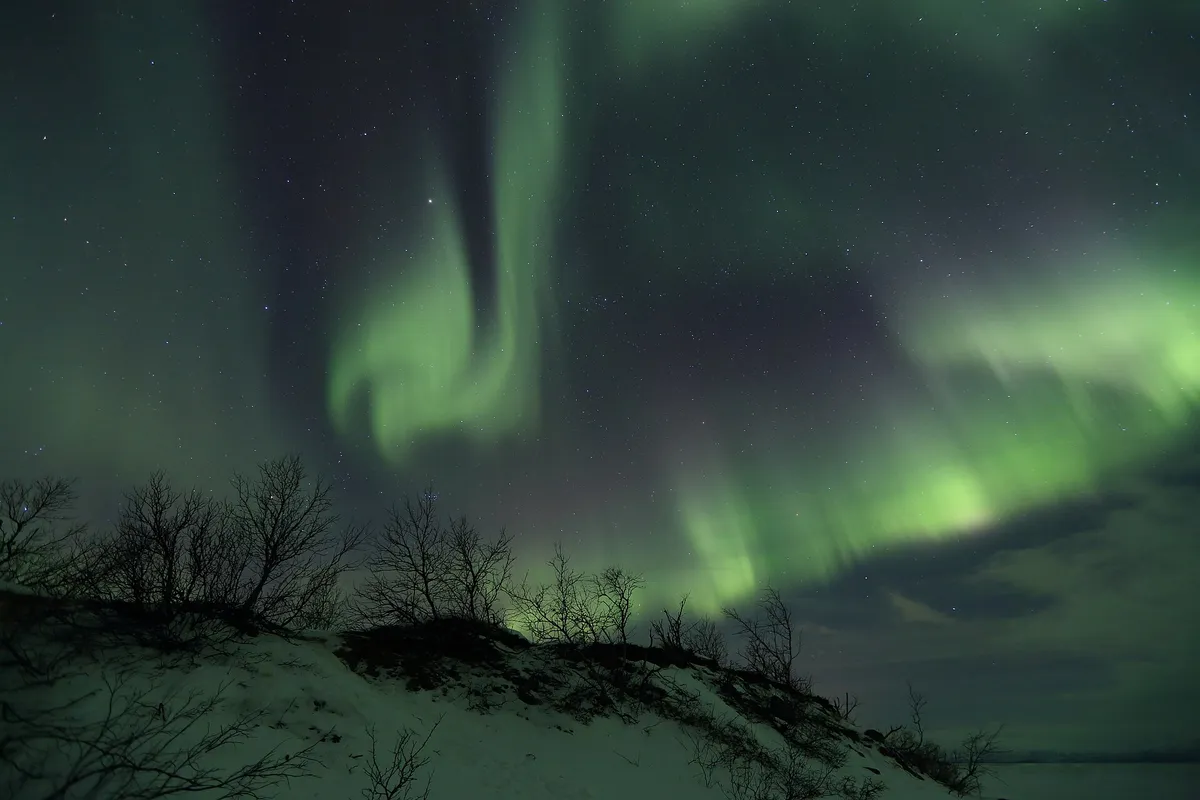
Geomagnetic activity has a seasonal shape, and it is not an impression. NOAA credits subtleties in how the solar wind meets the magnetosphere; the Geophysical Institute names it the Russell-McPherron effect, strong but poorly understood, and quantifies it for Interior Alaska: your chance of seeing the aurora is roughly twice as high at the equinox as at the solstice.
The raw record comes from GFZ in Potsdam. In the official Kp index record since 1932, counting days whose maximum three-hour Kp reaches 5 or more, at least a G1 storm, December is the worst month at 9.4% and April the best at 21.5%; March sits at 21.3% and September at 20.7%. Group the four months around the equinoxes against the four around the solstices and it is 20.8% against 11.8%, a ratio of 1.77, rising to 1.81 over the last thirty years.
No official source resolves this below the month, so hunting for "equinox week" is wasted effort, and near the March equinox the hours of darkness shrink fast, a caveat NOAA raises for travellers. The equinoxes bracketing this season fall on 23 September 2026 and 20 March 2027.
Northern lights 2026 and 2027: the solar cycle is already past its peak
On 15 October 2024 NASA and NOAA announced that the Sun had reached the maximum phase of Solar Cycle 25, with two caveats that usually vanish from headlines: the maximum is a period, not a date, and the real peak is identified only months later, once the decline is confirmed.
That decline is now visible. In NOAA's observed record the highest smoothed sunspot number of the cycle, 160.9, sits at October 2024, and the latest published value, January 2026, is 104.2. The forecast for the season ahead drifts from about 96 in September to about 87 in March 2027.
The counterintuitive part sits in the same Kp record. Days with a G1 storm or stronger, September to March: 21 in the 2022 to 2023 season, 24 in the next, 25 in the one that contained the announced maximum, 47 in the last completed one. The busiest of the four came after the peak. The Geophysical Institute writes that auroral activity tends to peak roughly a year after solar maximum, and NOAA warns that significant storms also occur in the declining phase. The strongest three-hour Kp of 2026 so far, on preliminary values, is 8.667 on 19 January.
The Kp index: what it tells you and what it does not
Kp runs from 0 to 9 and measures planetary geomagnetic disturbance. NOAA's viewing tips page gives the working rule: at Kp 0 the equatorward edge of the oval sits near 66 degrees geomagnetic and drops about 2 degrees per level, down to 48 degrees at Kp 9, with the warning that this is an average.
The line that matters to a traveller is a different one, also NOAA's: in the right place under the aurora you can see very nice displays even with low activity, Kp 3 or 4. Fairbanks says it from the other end: inside the oval Kp matters less, because local activity can be high while global activity is low. Nor need it be overhead: with a clear northern horizon, when the aurora is bright and conditions are right, it can be seen from as much as a thousand kilometres away.
High Kp only matters if you are chasing from lower latitudes: on NOAA's scale G2 reaches New York and G5 Florida, and in May 2024 the lights were seen from India and Mexico. Chasing that from Manchester is a lottery; going under the oval is a plan.
Cloud cover matters more than any aurora app
This is the part that ruins the most trips. The aurora sits above the weather: closed sky, no aurora. The Geophysical Institute treats clear sky as a site selection criterion, not a detail, and no aurora product is a weather forecast. NOAA's 30 minute forecast runs the OVATION model and has that margin only because that is the solar wind's travel time from L1. The Kp bulletin runs to three days, the recurrence outlook to 27, and none looks at cloud.
The people who live with it worked this out long ago. The Icelandic Met Office aurora forecast is first of all a cloud map with an hourly slider, the activity number in a corner box, while the Finnish service starts from magnetometers. An example from the day we are writing, 9 August 2026: NOAA records a maximum Kp of 6, a G2 storm, in the previous 24 hours, then forecasts 3.67 for the three days after. You cannot build a holiday on that.
The practical consequence comes from the Norwegian centre: the coast is mild but cloudy, and some travellers move inland and accept colder temperatures. Precipitation is a proxy for cloud, not a measurement, but the gap shows: in January Tromsø averages 19 precipitation days, Kiruna 16.1, Rovaniemi 10.
Cold, moonlight, and what your eye cannot see
The January averages, with the reference period named because it varies by country, sketch the coast-versus-inland trade-off.
- Reykjavík, 1961 to 1990: mean daily maximum 1.9 °C, mean daily minimum minus 3 °C
- Tromsø, same period: maximum minus 2.2 °C, minimum minus 6.5 °C
- Kiruna, 1991 to 2020: maximum minus 7.2 °C, minimum minus 16 °C
- Rovaniemi, 1971 to 2000: maximum minus 8.5 °C, minimum minus 15.1 °C
- Fairbanks, 1981 to 2010: maximum minus 16.8 °C, minimum minus 25.3 °C
- Yellowknife, 1971 to 2000: maximum minus 22.7 °C, minimum minus 30.9 °C
Those are averages, not a forecast for your night, and you will stand still outdoors for hours. The Swedish Tourist Association tells visitors to bring their warmest hat and gloves, thermal base layers and a head torch with a red light, which does not destroy your night vision.
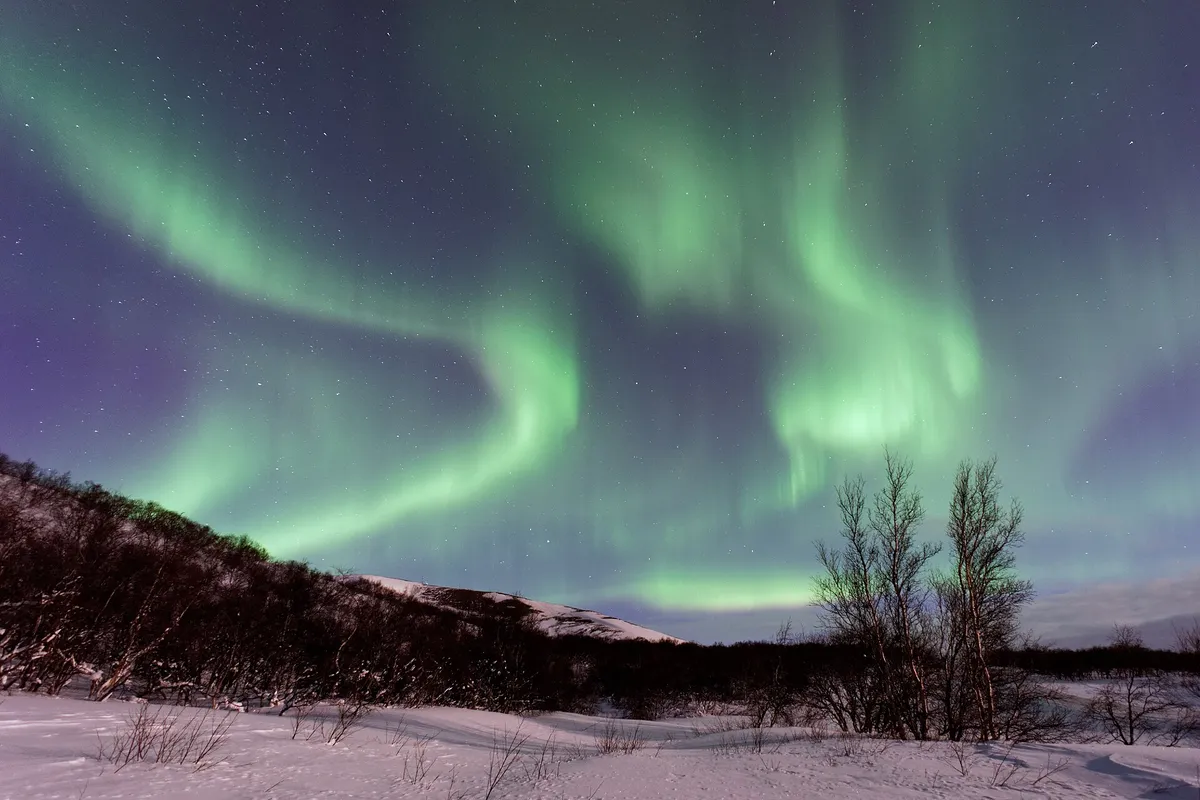
NOAA is short on the moon: a full moon reduces the apparent brightness of the aurora. Fairbanks adds the nuance most guides skip: the same light switches on the cone cells in your retina and lets you perceive more colour, while in full darkness the rods do the work, in black and white. For photography they recommend the third quarter or a new moon: this season's new moons fall on 11 September, 10 October, 9 November and 9 December 2026, then 7 January, 6 February and 8 March 2027. The same biology explains everyone else's photographs: a phone gathers more light than the eye and, pointed north, tells you something is there before you can see it.
Where to stay: mild wet coast or cold dry interior
The whole choice of base sits there. Tromsø is convenient and under the oval, and the local tourist board admits the lights are often visible from a hotel window while still advising you to leave the city lights behind. Our guide to where to stay in Tromsø covers the districts; the price of the convenience is cloud.
Move inland and the sky opens as the thermometer drops. Abisko is known for what the Swedish Tourist Association calls the blue hole, a sky often clear while it is overcast nearby, and the Aurora Sky Station sits 900 metres up Mount Njullá, reached by a half-hour chairlift and open until 01:00 in winter. The bases are Abisko and Kiruna, and Finnish Lapland repeats the pattern around Rovaniemi.
Reykjavík is the mildest of the bases and, by aurora standards, a wet one: 75.6 mm over 13.3 precipitation days in January, WMO 1961 to 1990. In exchange the met office hands you an hour by hour cloud map. In Greenland the tourist board warns that the best displays often come in the middle of the night, alarm at 2:30 am included, while Fairbanks and Yellowknife are the cold, dry end of the scale. Svalbard also has daytime aurora, because in the polar night it is dark at noon, though the Norwegian centre notes it is weaker: treat it as a bonus.
How many nights to book to see the northern lights
The only figures attributable to a scientific institution come from the University of Alaska Fairbanks. Under dark and clear conditions, three to seven days makes it most likely that you see the aurora, and three nights make it highly likely, though never certain. Both figures carry the same condition, a clear sky, the one variable you cannot book. Visit Tromsø gets there from the practical side: the more nights you spend, the better the chance activity and weather cooperate.
- Three nights is the sensible minimum; five or six make the trip calmer.
- Prefer rates with free cancellation, because the move that saves the trip is going inland when the coast closes in: see the guide to free cancellation, while non-refundable rates make little sense here.
- Spread the nights across small towns rather than one famous hotel: the real alternative is geographic, not a question of which hotel.
- Skip the two ends of the season the Geophysical Institute advises against.
- Aim near the new moons above and move early, as the guide on when to book a hotel argues.
No official source publishes a probability for a three or five night trip, so anyone quoting one is selling you something. Check what your travel insurance covers, because up there the real risk is flights and weather.
Edenfinder is a technical intermediary: it compares availability and prices across platforms and shows the real total for the stay, while the booking is completed on the supply partner rail with Nuitee as merchant of record. Compare available rooms in Tromsø for the number of nights the aurora asks for, and keep Abisko open for the night the coast closes.
Edenfinder
Paradise has a price. We find it lower.
We compare prices for the same hotels across every major booking platform, with direct links to the right page.
Search your hotel →Frequently asked questions
Now that solar maximum has passed, is it still worth going in the next few years?
Yes, and under the auroral oval the state of the solar cycle counts for far less than the headlines suggest. The Geophysical Institute in Fairbanks notes that viewing at high latitudes does not depend much on solar maximum, because the oval is normally there anyway, and Visit Tromsø cites research showing that the expansion of the oval makes little difference directly beneath it. Solar activity mainly shifts the odds at lower latitudes, and the Norwegian Centre for Space Weather points out that eruptions big enough to produce aurora can happen at any point in the cycle.
Can I pick my travel dates from an aurora app?
No: the aurora part of any app is a nowcast, not a planning tool. NOAA's OVATION model looks 30 to 90 minutes ahead, and only because that is how long the solar wind takes to reach us from the L1 point; the longest official geomagnetic products are the three day Kp forecast and the 27 day recurrence outlook, and no agency publishes a seasonal aurora forecast. Two details worth knowing this season: in May 2026 NOAA removed the view line from its experimental tonight and tomorrow night product, which covers North America only, and swpc.noaa.gov addresses now redirect to spaceweather.gov.
Do I need a guided tour to see the northern lights?
No. Visit Tromsø says the lights are often visible even from a hotel window in town, while still advising you to leave the city lighting behind. What an organised outing actually buys is movement, toward a darker or a clearer sky; if you book dog sledding or a snowmobile trip instead, those operators usually supply thermal suits and winter boots. Book it early anyway: Visit Tromsø warns that aurora activities are often fully booked and that most of them do not run before early September.
Is the sky over Abisko really clearer than over Tromsø?
It is drier, which is not the claim you usually read. No weather service publishes a clear night comparison between the two, so figures like “twice as many clear nights” come from tour operators, not from SMHI or any meteorological authority. What is measurable is precipitation: about 108 mm in Abisko from November to March against roughly 468 mm in Tromsø, with different reference periods (1991-2020 and 1961-1990) and with rain standing as a hint of cloud rather than a measurement of it.
Why does the aurora look grey to the naked eye and green in photographs?
Because in the dark your vision runs on the rods in the retina, which catch shape and movement but not colour. The Geophysical Institute explains that colour appears once there is enough light to switch on the cones, either from a brighter aurora or from moonlight, which is why a full moon can hide faint detail and make colour easier to read at the same time; NOAA adds that it reduces the aurora's apparent brightness, not its actual brightness. A phone gathers more light than the eye through longer exposures, wider apertures and the stacking of several frames, so pointing one north on a clear night is a legitimate way to check whether anything is happening.
From the same section