Destinations · September 6, 2026 · 9 min read
Where to stay in Tenerife, and the best time to visit
Two coasts and two climates: 132 mm of rain a year in the south against 520 in the north, and hotel rates that peak in March rather than in August.
Two AEMET weather stations on the same island. Tenerife Sur records 132 mm of rain a year across 15.2 rain days. Tenerife Norte records 520 mm across 64 days, plus 77.7 days of fog. Picking a coast here is picking a climate, and the hotel page you are looking at will not mention it.
The second surprise is that the price curve runs backwards. In Adeje, INE's hotel rate series peaks in March 2026 at €218.38 and bottoms in May 2026 at €153.41. Winter sun is the expensive season on Tenerife, which is the reverse of what the winter sun numbers usually lead people to expect.
Where to stay in Tenerife, area by area
Tenerife's accommodation revenue in 2025 was €2,121,285,464, and Adeje took 44.5% of it, Arona 25.6% and Puerto de la Cruz 11.2%. Four fifths of the money lands in three municipalities. The usual rules for choosing a neighbourhood hold here too, but the coast comes first and the street second.
Costa Adeje
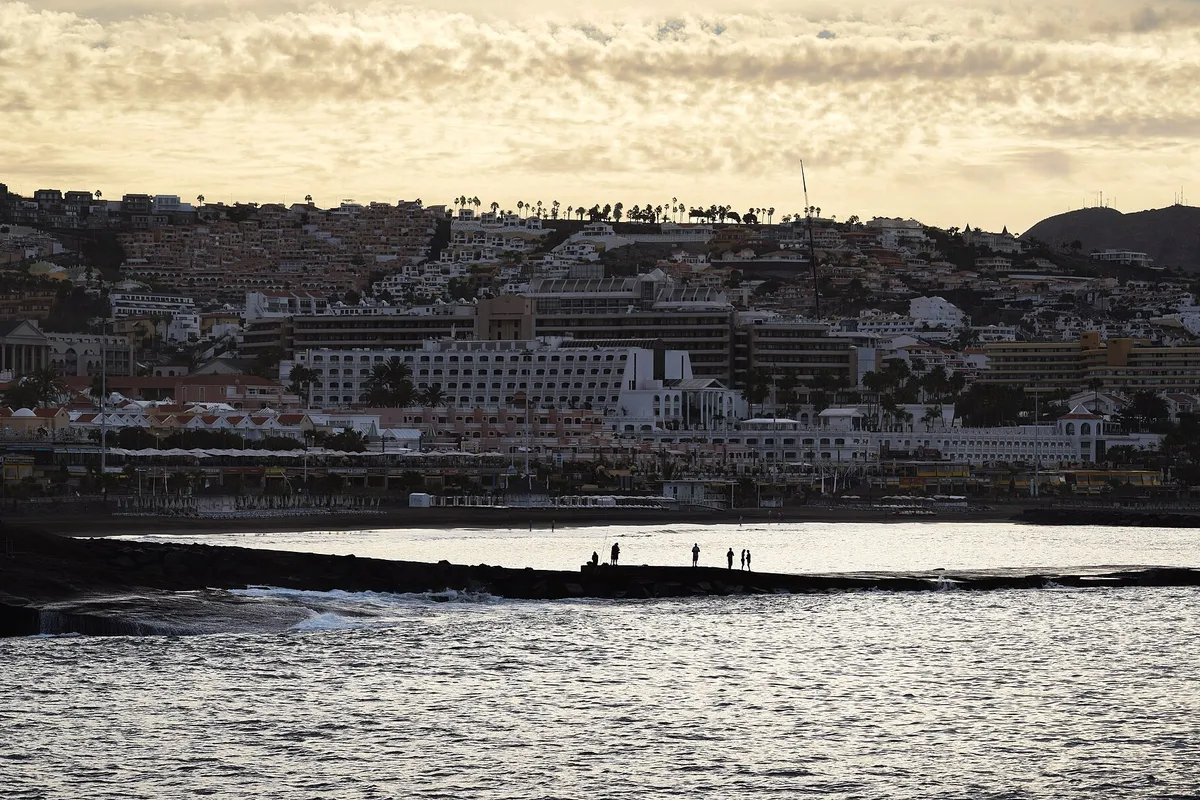
Adeje covers 105.94 km2 with 50,021 residents, and the strip runs from Playa de Troya in the east to Callao Salvaje in the west, weighted to four and five star. Siam Park and the Barranco del Infierno reserve are here. Occupancy was 79.5% in 2025, and two beaches hold a Blue Flag on ADEAC's 2026 to 2027 list, El Duque (Sur) and Torviscas. Fañabé does not.
Playa de las Américas
Part of Arona: 84.6 km2, 87,793 residents, and four distinct areas that also take in Los Cristianos, Las Galletas and rural Arona inland. Américas is the nightlife end. I will not tell you which streets are quiet: neither Arona nor Adeje publishes a noise ordinance or a licensing map I could find. What is checkable is that no beach here holds a 2026 to 2027 Blue Flag, and Arona averaged about €133 a night in 2025 against roughly €176 in Adeje.
Los Cristianos
A former fishing village that became the ferry port. Playa de las Vistas is 850 m by 80 m, pale sand, calm water behind breakwaters, an artificial island and parking for over a hundred cars. It is the only Arona beach with a 2026 to 2027 Blue Flag; the town's own beach lost the one it held in 2025. The real argument for staying here is the harbour: San Sebastián de La Gomera is 50 minutes and 21 nautical miles away, up to four sailings a day, with Gran Canaria at 80 minutes and La Palma at 150.
La Caleta and Callao Salvaje
Turismo de Tenerife's beach directory carries no page giving dimensions or sand type for either, and the pages for Playa del Duque and Playa de Fañabé return errors. The only sourced fact is positional: Callao Salvaje is the western limit of the Costa Adeje strip, which puts both furthest from the Américas nightlife and from the airport bus corridor. Anyone giving you precise beach descriptions here is not reading an official source.
Los Gigantes and Playa de la Arena
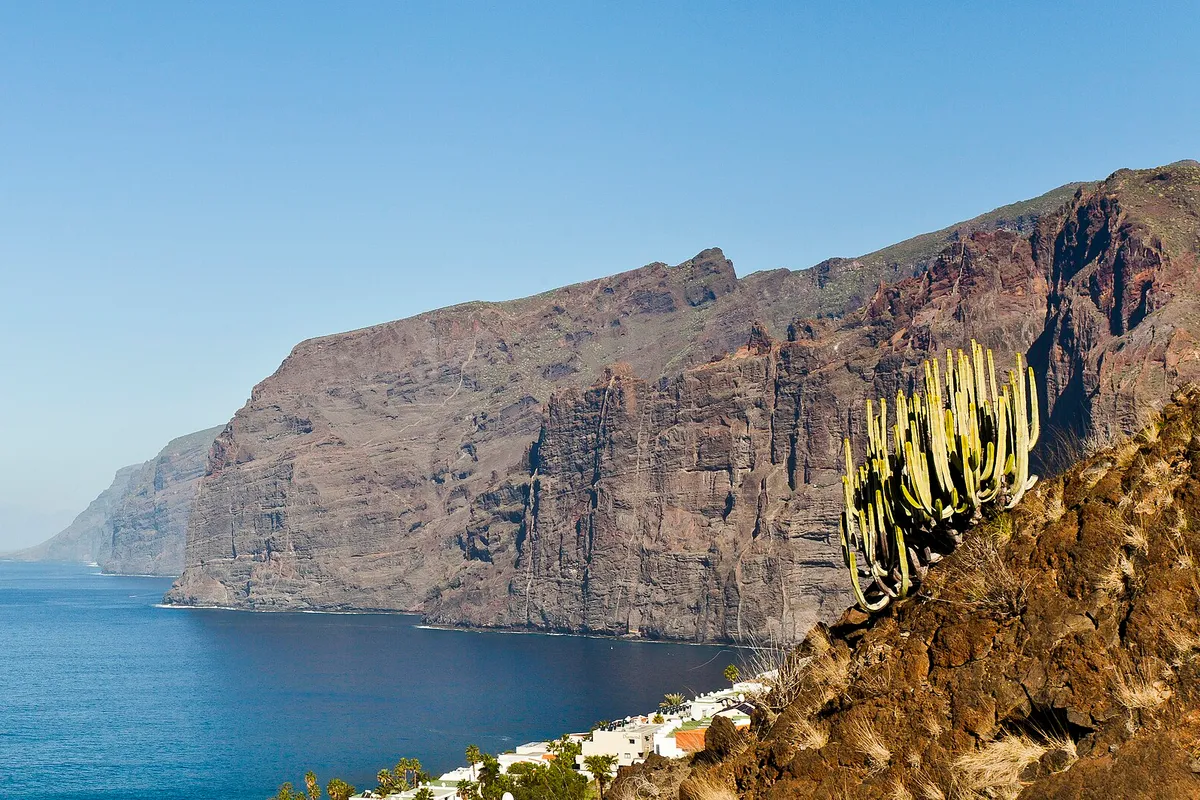
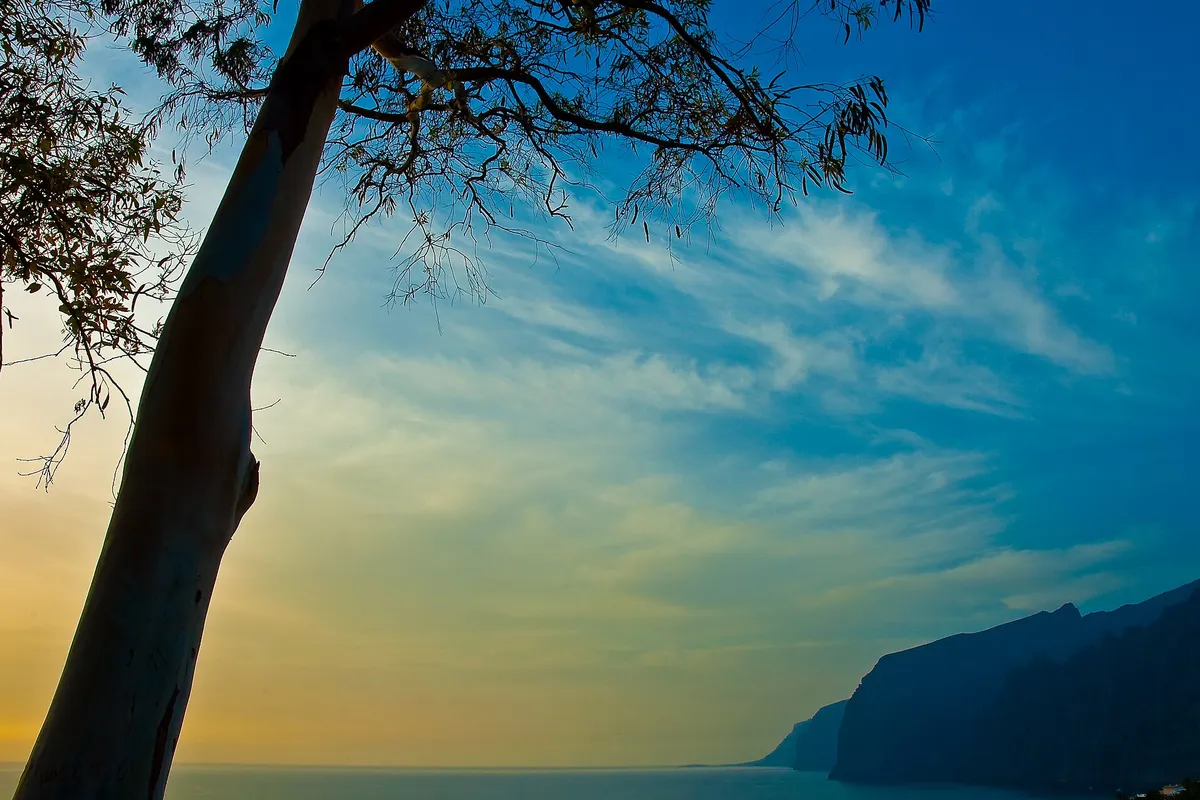
Santiago del Teide, 12,582 residents, and the highest municipal occupancy on the island in 2025 at 84.9%. The cliffs rise up to 600 m out of the water inside Teno Rural Park. Three settlements: Los Gigantes with the marina and the whale watching departures, Puerto de Santiago, and Playa de la Arena, black volcanic sand and calm water. The tourist board claims a Blue Flag for Playa de la Arena; Santiago del Teide is not on the 2026 to 2027 list.
El Médano
Granadilla de Abona, 58,752 residents, the lowest occupancy of the big municipalities at 59.3%, which tells you it is a town first. Tenerife Sur airport is in the same municipality. The beach is 750 m by 43 m, fine grey sand, under the Montaña Roja cone: calm and shallow at the town end, the island's windsurf and kitesurf water at the far end. A PWA World Cup ran here from 31 July to 9 August 2026, so early August is windy and full.
Puerto de la Cruz
The smallest municipality at 8.7 km2, 31,137 residents, a National Tourist Interest Site since 1955 and the first tourist destination in the Canaries, off the back of nineteenth century British medical advice. The old quarter holds more than 140 protected buildings, and the Lago Martiánez lido sits inside the Costa Martiánez complex. Playa Jardín is black volcanic sand, 240 m by 40 m, designed by César Manrique, swimmable inshore and rough beyond the breakwaters. It is the cheap option among the big three: INE's twelve month mean for 2025 was about €87 here against about €176 in Adeje. Half the price, grey skies more often.
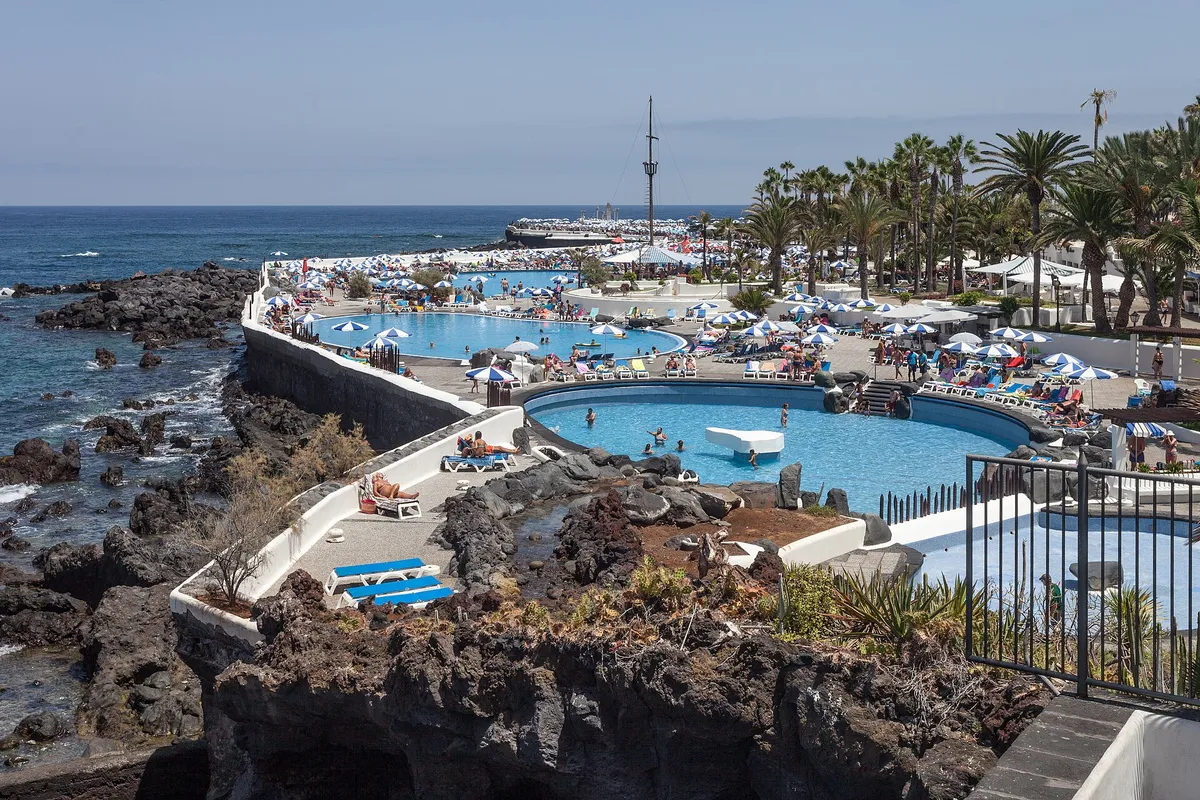
Santa Cruz and La Laguna
Santa Cruz has 211,957 residents and La Laguna 161,108, with 2025 occupancy of 63.0% and 62.1%. These are working cities with tourism inside them. La Laguna joined the UNESCO list in December 1999 as the first non fortified colonial city, its 1500 layout intact. Las Teresitas is honest about being artificial: 1.3 km by 80 m, pale sand brought from the former Spanish Sahara, held by a breakwater and an underwater step, 7 km from the centre at San Andrés.
Garachico
29.28 km2, 4,940 residents, and a town shaped by one night in 1706, when the Trevejo eruption destroyed the port and most of the buildings. The lava that reached the sea cooled into El Caletón, the natural pools where people swim today. Small hotels, rural houses, apartments. Rock pools, not sand.
The north south split, in numbers
AEMET's normals for 1981 to 2010 make the split arithmetic rather than opinion. Annual rainfall: 132 mm at Tenerife Sur, 226 mm at Santa Cruz, 520 mm at Tenerife Norte. Rain days: 15.2, 29.7 and 64.0. January sunshine: 193 hours in the south, 178 in Santa Cruz, 150 in the north.
One caveat belongs in the same sentence as those numbers. The Tenerife Norte station sits at 632 m on the La Laguna plateau, so it is colder than sea level Puerto de la Cruz and its January mean maximum of 16.0 °C is not a beach temperature. Use it for rain and cloud. AEMET lists a Puerto de la Cruz station and returns an empty table, so no official sea level series exists for the north coast.
The fog count names the phenomenon: 77.7 days a year at Tenerife Norte, peaking at 10.7 in July, against 0.3 days at both Santa Cruz and Tenerife Sur. That is the panza de burro. The trade wind inversion under the Azores high traps humid air below a subsidence layer: the windward north sits inside the stratocumulus, the leeward south stays clear. The north is green because it is wet, and wet because of the cloud that spoils the sunbathing.
Two things I will not put numbers on: sea temperature by month, because AEMET's normals carry air only, and the frequency of calima, the Saharan dust episodes. Both are real.
What it costs, and the month that costs least
INE's hotel rate series by tourist point, which covers hotels only:
- Adeje: €218.38 in March 2026, €212.63 in February and €202.17 in December 2025, against a floor of €153.41 in May 2026 and €137.15 in June 2025.
- Arona: €159.06 in December 2025 and €155.17 in January 2026, down to €110.32 in May 2026.
- Puerto de la Cruz: €107.44 in March 2026 and a second, smaller peak of €106.28 in July, against €71.02 in May 2025. That July bump is the domestic market, and the south does not have it.
Moving out of February to April and into May or June cuts the average rate by roughly a quarter to a third. Availability barely moves: bed place occupancy in Adeje ranged only between 70.44% and 86.25% across the fourteen months to July 2026. Tenerife has no low season by volume, only by price, which changes when you should book.
Four checks before you confirm:
- Price the same room in May or June against your February date. Less than 15% apart and the hotel is not following the market.
- Check whether the rate is a hotel or a holiday apartment. Tenerife's 19,257 holiday homes averaged €147.84 a night in 2025, above four star hotel level, so the apartment is not automatically cheaper.
- If a Blue Flag matters, read the ADEAC list rather than the hotel page. Eleven Tenerife beaches hold one for 2026 to 2027, and Playa de las Américas, Fañabé, Los Cristianos, El Médano, Las Teresitas and Playa Jardín are all absent.
- Read the total, not the nightly rate, and check what the property adds at the desk.
On tax, Tenerife charges you nothing for sleeping. The Cabildo formally rejected a per night levy in May 2025, and the island tax proposed by its president Rosa Dávila lacks her coalition partner's support. The subject keeps returning because of Mogán on Gran Canaria: €0.15 per person per night approved in February 2025, €1.4 million in its first year, and the ordinance annulled by the Canary high court on 13 July 2026 for camouflaging a tax behind vague service definitions. Mogán is still charging it while it appeals to the Supreme Court, the money frozen. La Oliva on Fuerteventura approved the second on 20 March 2026, and after the ruling the Canary government restated that it prefers to raise money through IGIC. For the rest of the continent, see tourist taxes in Europe and resort fees.
The Canaries sit outside the EU VAT area and levy IGIC instead, at a general rate of 7%. No primary Canary source states which IGIC rate applies to a hotel night, so I will not hand you a comparison with the mainland.
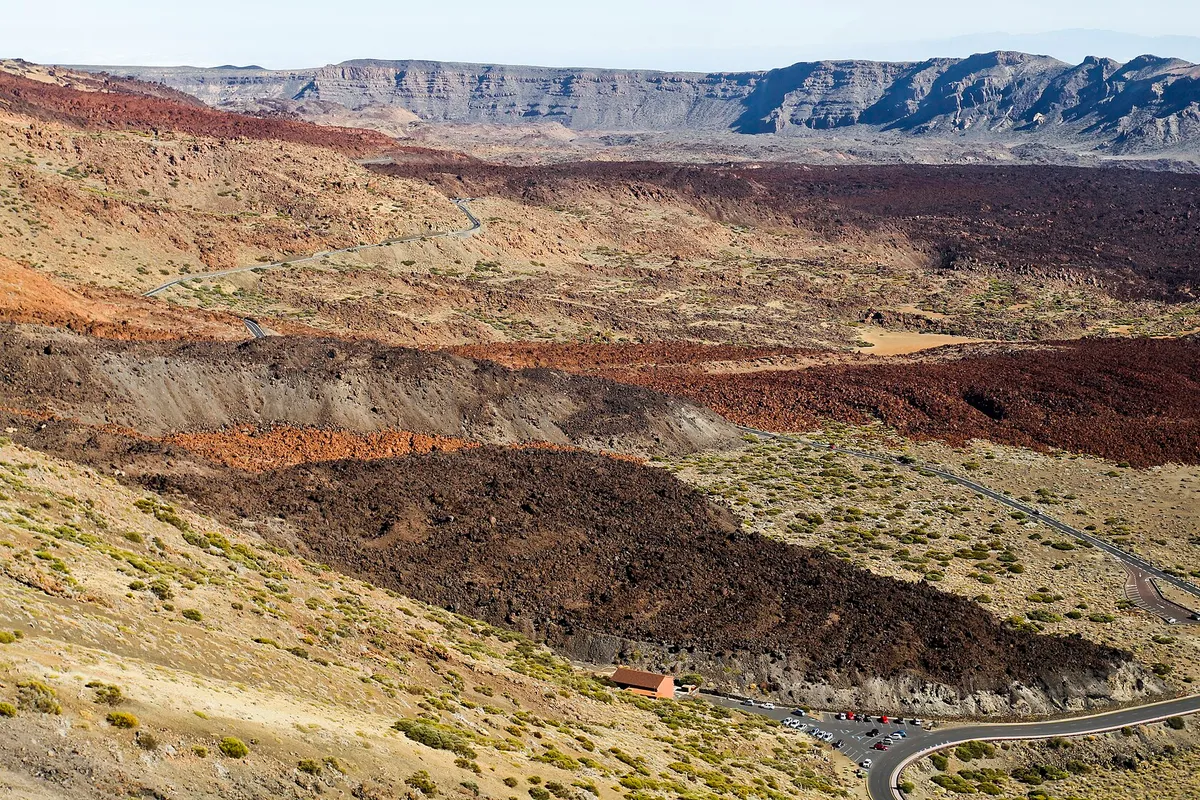
Teide, and what changed in 2026
From Monday 19 January 2026 the Cabildo charges non residents on two national park trails, which is new enough that most guides still call the walk free.
On PNT-10 Telesforo Bravo, the final section to the crater, between 09:00 and 17:00: Tenerife residents free, under fourteens free, residents of the other Canary Islands €6, everyone else €15. On PNT-07 from Montaña Blanca to La Rambleta, between 09:00 and 15:00: on weekdays free, €3 and €6; at weekends and on public holidays free, €5 and €10. Slots go through the Cabildo's Tenerife ON platform, opening Mondays at 07:00 Canary time on a rolling 28 day window, and the tariff is set out in the Cabildo's January 2026 announcement of the charge. You need a card and every walker's ID, the permit is void if the named person does not appear, and nothing is refunded except weather closures.
Entering the park and driving the TF-21 are still free. The charge is on footpaths, and it is not only a Teide story: Tenerife now charges non residents on five trails island wide. The Barranco de Masca has cost €28 since 11 July 2024 (€3 for Canary residents from other islands, free for Tenerife residents), far dearer than anything on the volcano, and Pijaral in Anaga became the fifth in April 2026. Tenerife taxes nobody's bed and charges for five footpaths.
It worked. Press reporting in early March 2026 put first month visits on the two paid trails at 10,890 against 38,200 before, a fall of about 71%. On 7 May 2026 the Cabildo took over full management of the park, aiming to cut human pressure by up to half. More has been announced, from parking quotas to shuttle buses, but none of it was in force at the start of September 2026.
Teide is 3,715 m according to the environment ministry, even though 3,718 m is still printed everywhere. If you go up in January, AEMET's Izaña observatory at 2,369 m averages a daily maximum of 7.5 °C, a minimum of 1.1 °C and 12.3 frost days, with the summit another 1,350 m above it. On cable car fares I have nothing: the operator's price page would not load.
Getting there and getting around
Tenerife Sur handled 13,969,678 passengers in 2025, up 1.7%. Tenerife Norte handled 7,174,977, up 6.1%. Sur is roughly twice the size and takes the northern European charters; Norte is the inter island and mainland Spanish airport and is growing much faster.
TITSA line 40 runs Costa Adeje to Los Cristianos to Tenerife Sur in about 40 minutes, first bus at 05:30 and last at 21:40, with night line 711 outside those hours. Line 10 does Santa Cruz to Tenerife Sur in about 55 minutes. Line 343 is the express from Puerto de la Cruz to Costa Adeje calling at both airports, about 100 minutes, which is the honest answer for reaching the north coast from the southern airport. Correct one thing you will read elsewhere: line 111, the Santa Cruz to Costa Adeje motorway service, stops at Cruce Aeropuerto on the TF-1 but does not enter the terminal.
TITSA's tourist card costs €10 for one day and €50 for seven, and it excludes the Teide and Teno lines, which is exactly the journey you would buy it for. The rechargeable ten+ card costs €2; a return starts at €4.25 with 10% off journeys of 20 km or more. The subsidised monthly passes, €19 for residents and €15 for under thirties, over sixty fives and 33% disability holders, all require Canary residency.
I found no official taxi or transfer tariff for either airport, so there is no range here to quote. Check the coach situation before you prepay one: in July 2026 Aena imposed a new charge on discretionary coaches at Tenerife Sur, the Cabildo asked for it to be withdrawn immediately, and the sector warned of problems from October 2026.
Whether you need a car is a judgement, not a fact, so here are the facts to judge on. Forty minutes airport to Costa Adeje by bus, fifty five to Santa Cruz, an hour and a half across the island, and no volcano on the cheap pass.
When to go
Carnival is the date that catches people out, and 2027 is worse than usual because Santa Cruz moved it back two weeks. The opening gala is on 22 January 2027, the Gala de Elección de la Reina on 17 February, the opening cabalgata on 19 February and the Coso on 23 February, with street carnival from 19 to 28 February. Ash Wednesday 2027 falls on 10 February and the calendar Shrove Tuesday on 9 February, so the big parade is a fortnight after the week most people would book by instinct. Santa Cruz hotel rates peaked at €127.38 in February 2026 against €92.25 in August 2025: Carnival is the one week when the capital, not the coast, is the expensive place to sleep.
Canary school holidays for 2026 to 2027 run from 22 December 2026 to 7 January 2027, classes back on 8 January, and from 22 to 26 March 2027 for Easter. Easter Sunday 2027 is 28 March, so the Canarian break finishes before Holy Week and northern European Easter demand arrives days later. Two peaks, not one.
That leaves May and June as the cheap months, September and October as the shoulder that November extends, and early August at El Médano as the week to avoid if you want a quiet beach. Supply is tightening too: a 2025 Canary law now requires explicit municipal authorisation for holiday lets, and Canarian reporting counts roughly 7,000 homes lost from the market in its first seven months.
Choose the coast first, the hotel second
Decide whether you want 132 mm of rain a year or 520. Decide whether you are paying March prices or May prices. Then, and only then, open the hotel list. Those two calls matter more than any individual property, which is the same logic behind our area guides to Valencia and Naples.
When you are ready to compare live prices, start with hotels in Tenerife or narrow it to Costa Adeje. Our destination hubs cover the rest.
Edenfinder
Paradise has a price. We find it lower.
We compare prices for the same hotels across every major booking platform, with direct links to the right page.
Search your hotel →Frequently asked questions
Is the north or the south of Tenerife better for winter sun?
The south, and AEMET's normals show by how much. Tenerife Sur records 132 mm of rain a year across 15.2 rain days and 193 hours of sunshine in January. Tenerife Norte records 520 mm across 64 rain days, 150 hours in January and 77.7 days of fog a year. The north is green for exactly that reason, so it is the better choice if you came to walk rather than to lie down.
Is there a tourist tax in Tenerife?
No. There is no overnight tourist tax anywhere on Tenerife, and the Cabildo formally rejected a per night levy in May 2025. The confusion comes from Mogán on Gran Canaria, which charges €0.15 per person per night; its ordinance was annulled by the Canary high court on 13 July 2026 but is still being applied while the town appeals to the Supreme Court. La Oliva on Fuerteventura approved a second one on 20 March 2026.
Do you have to pay to climb Teide now?
Since 19 January 2026, yes, on two trails. The Telesforo Bravo path to the crater costs €15 for visitors and €6 for residents of other Canary Islands between 09:00 and 17:00, and is free for Tenerife residents and under fourteens. Montaña Blanca to La Rambleta costs €6 on weekdays and €10 at weekends and on public holidays, between 09:00 and 15:00. Entering the park and driving the TF-21 remain free, and slots are booked through the Cabildo's Tenerife ON platform.
Which month is cheapest for a hotel in Tenerife?
May, followed by June. INE's hotel rate series for Adeje bottoms at €153.41 in May 2026 against €218.38 in March 2026, and Arona bottoms at €110.32 in May against €159.06 in December. That is a cut of roughly a quarter to a third for the same room. Occupancy barely changes across the year, so this is a price effect rather than an availability one.
Do I need to hire a car in Tenerife?
Only if you plan to leave the resort strip regularly. TITSA line 40 reaches Tenerife Sur airport from Costa Adeje in about 40 minutes, line 10 reaches Santa Cruz in about 55, and crossing the island takes about an hour and a half. The catch is that the €10 and €50 tourist cards exclude the Teide and Teno routes, so the volcano and the Masca side of the island are the trips public transport serves worst.
From the same section